
by Leon Ashcombe
Share
by Leon Ashcombe
Share
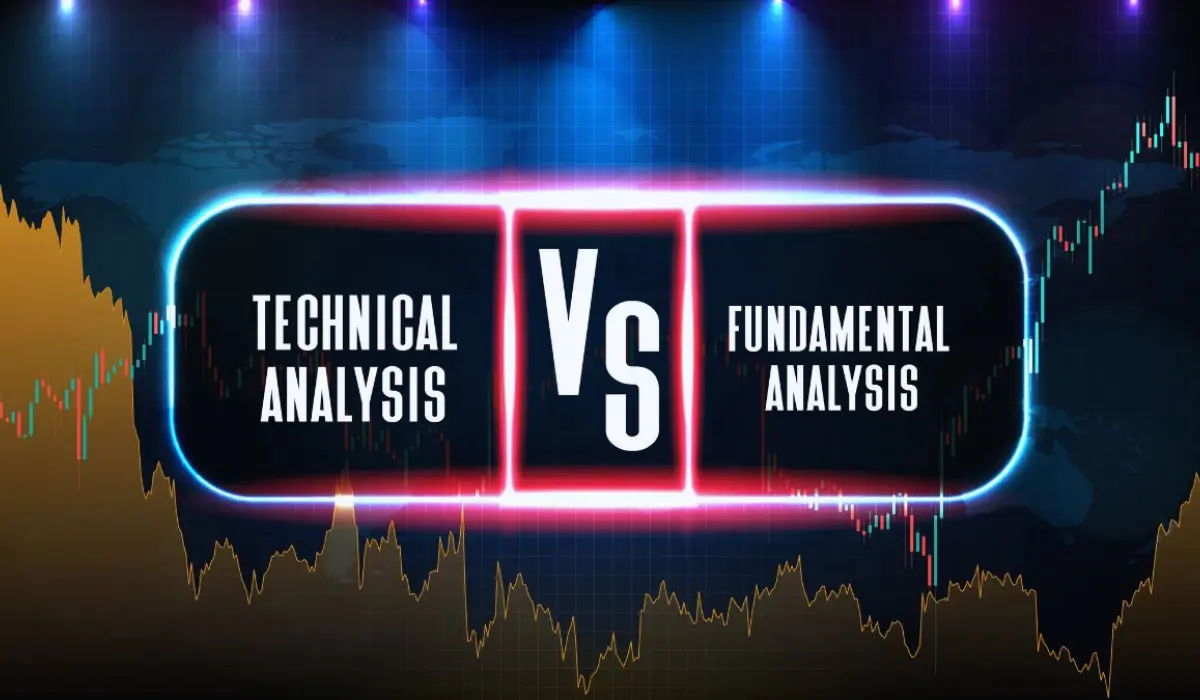
Investing in global financial markets requires smart decision-making skills. Fundamental and technical analysis are the two main methods used to examine cryptocurrencies, stocks, and other financial assets. Though the main purpose of both is to help traders spot potential trading opportunities, they are quite different in terms of methods followed, objectives, and data sources.
Understanding the difference between fundamental and technical analysis can help investors build the right strategy based on their financial goals, investment horizon, and risk tolerance.
What is Fundamental Analysis?
This is a method of calculating the intrinsic value of an asset by examining financial, economic, and qualitative factors. The main purpose is to know if an asset is undervalued or overvalued compared to its current market price.
It looks at factors such as the company’s revenue and earnings, balance sheets, profit margins, industry performance, cash flow statements, economic conditions, management quality, and interest rates and inflation.
For example, if the financial health of a company is strong and its stock price is lower than its estimated value, a fundamental analyst sees this as a buying opportunity.
What is Technical Analysis?
Technical analysis gives importance to price movements and trading volume rather than a company’s financial performance. Technical analysts believe that all the necessary data is reflected in market prices.
This method uses indicators, charts, and historical data to predict future trends in prices. Some common technical analysis tools include support and resistance levels, candlestick patterns, moving averages, trend lines, the Relative Strength Index (RSI), MACD (Moving Average Convergence Divergence), and volume analysis. Technical traders look for patterns and signals to understand when to enter or exit positions.
Differences Between Fundamental and Technical Analysis
| Factor | Fundamental Analysis | Technical Analysis |
| Focus | Intrinsic value of an asset | Market trends and price movements |
| Data Used | Economic data, financial statements | Trading volume and price charts |
| Time | Long-term | Short-term to medium-term |
| Objective | Spot undervalued or overvalued assets | Predict future price movements |
| Decision Basis | Business performance and valuation | Market behaviour and patterns |
| Suitable For | Investors | Traders |
These differences make both methods suitable for different types of market participants.
Advantages of Fundamental Analysis
Fundamental analysis has several advantages.
1. Identifies True Value
Based on financial performance and growth potential, it helps investors understand the real value of a company.
2. Supports Long-Term Investing
This method is best for investors who are into long-term investing.
3. Evaluates Business Quality
Investors can easily examine management effectiveness, competitive edges, and future business prospects.
4. Lowers Speculation
The decisions are made based on measurable data rather than short-term market sentiment.
Advantages of Technical Analysis
Due to its speed and flexibility, technical analysis is popular among active traders.
1. Offers Clear Entry and Exit Signals
Using charts and indicators, traders can easily spot profitable buying and selling opportunities.
2. Works Across Markets
Technical analysis can be used in crypto, stocks, commodities, forex, and other markets.
3. Helps Manage Risks
Traders can limit losses by using stop-loss levels and trend analysis.
4. Understands Market Psychology
Price patterns suggest investor emotions like greed and fear, which can form trading opportunities.
Disadvantages of Fundamental Analysis
- Needs good financial knowledge and in-depth research
- Financial reports may not point to sudden market changes
- The intrinsic value of assets may vary among fundamental analysts
- Results may take a long time to materialize
Disadvantages of Technical Analysis
- Historical patterns do not always repeat
- Indicators may form wrong signals
- Chart patterns can get invalidated by market news
- Different analysts may read the same chart differently
Which Analysis is Better?
Well, the best method depends on individual goals. Fundamental analysis is better for long-term investors, portfolio building, retirement planning, and value investors. Technical analysis is ideal for day and swing traders, short-term traders, and active traders looking for quick opportunities.
Combining Fundamental and Technical Analysis
Combining fundamental and technical analysis can offer a more complete market perspective. Utilize fundamental analysis to spot strong companies with growth potential, while using technical analysis to find out the right time to buy or sell. This strategy helps investors improve trading time and choose quality assets.
Which Should Beginners Learn First?
Beginners can first learn fundamental analysis because it can offer a better understanding of how companies and financial markets function. Investors can easily examine the company’s performance and calculate long-term value.
Once this is done, they can learn technical analysis to enhance risk management and market timing. With this, beginners can build a more balanced and effective investment strategy.
Final Thoughts
Fundamental analysis and technical analysis are two important methods used to examine investment opportunities. While fundamental analysis focuses on a company’s intrinsic value and financial performance, technical analysis looks at price trends and market behaviour. Long-term investors choose fundamental analysis while active traders depend on technical analysis. Combining both methods can offer deeper insights and enhance decision-making.
STAY IN THE LOOP
Subscribe to our free newsletter.
Leave A Comment

Day trading is still opted for by traders interested in capitalizing on short-term movements. A major transformation has happened in the way people approach financial markets because of advances in technology, algorithmic trading, artificial intelligence, and live market data. The secret to successful trading is strong risk management and a disciplined strategy. In this article,

Artificial intelligence (AI) is transforming the trading industry like never before. AI-based trading bots are helping traders automate strategies, examine live market data, reduce emotional decision-making, and boost efficiency across multiple assets, including cryptocurrencies, stocks, forex, futures, and indices. Whether you are a novice trader seeking automation or an expert looking for advanced algorithmic tools,

Though trading helps make huge profits, it comes with several risks. Most traders enter the trading world with high expectations, but end up losing massive amounts due to careless mistakes. So, it is crucial to understand common trading mistakes and avoid them to build a stronger foundation for long-term success. In this article, we
In trading, volume is an important indicator, but many traders focus on price movements instead. Though price indicates where the market is moving, volume shows the strength behind that movement. With proper analysis of trade volume, traders can have clarity about market sentiment, confirm trends, and spot potential reversals. Understanding volume analysis can help make