Trading has evolved a lot in the last several years. Right now, traders have access to advanced AI-assisted tools, faster trading platforms, lower fees, and more educational materials. Though this is the case, the volatility of various markets has increased due to political and economic changes, interest rate changes, and other events.
This is why most beginners and even experienced traders are raising the same question, ‘Does day trading still work, or is swing trading better? Well, the answer is not that simple. Both strategies are good even today, but they suit different trading styles, risk levels, and financial goals. Some traders perform well in fast-paced environments, while others hold trades for a longer period to grab larger market trends.
This article delves into the details of day trading and swing trading, including the tools and indicators used, advantages and disadvantages, major differences between the two, best markets for these strategies, profitability, risk factors, and more.
Day Trading: An Overview
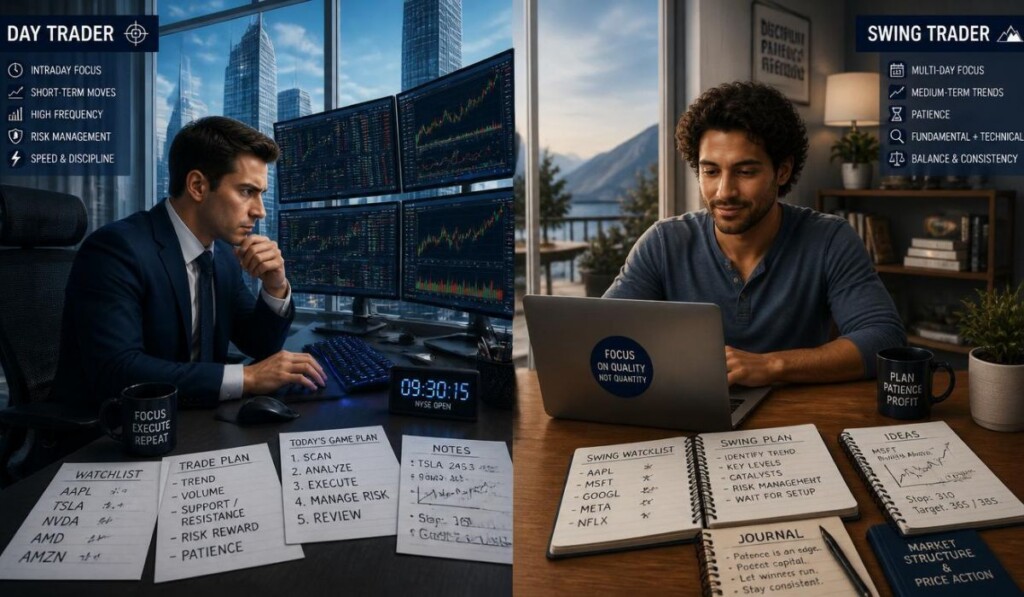
Day trading, as the name suggests, is a trading strategy where users buy and sell assets within the same day. To prevent overnight risk, traders close all positions before the market closes. The focus is on small price movements that occur throughout the day, and dozens of trades are executed. The financial instruments include forex, stocks, options, futures, and crypto. Day trading is intense, fast, and quick.
Day Trading Strategies
Common day trading strategies include:
- Scalping
- Momentum trading
- Breakout trading
- Trend trading
- Fading
- Mean reversion
Tools and Indicators
- Charts and indicators
- Technical analysis
- Live news feeds
- Fast execution platforms
- Stock scanners
- Level II quotes and time and sales
- Trade journal
Swing Trading: An Overview
Swing trading is a strategy where traders hold trades for days or weeks to capture larger market movements. The focus is on broader market trends instead of small price movements throughout the day. Profits are made from ‘swings’ in price momentum. Swing traders make dozens of trades per month in comparison to day traders, who do this in a day. This method is all about patience and holding a very few positions per week, but aiming for larger gains.
Swing Trading Strategies
- Trend pullbacks
- Support and resistance
- Breakout trading
- Chart patterns
- Fibonacci retracement
Tools and Indicators
- Moving averages
- Daily and weekly charts
- Technical and fundamental analysis
- Pattern recognition tools
- Stochastic oscillator
Day Trading Vs Swing Trading: Major Differences
| Feature | Day Trading | Swing Trading |
| Trade Timing | Minutes to hours | Days to weeks |
| Screen Time | Very high | Moderate |
| Overnight Positions | No | Yes |
| Risk Type | Intraday volatility | Overnight gaps |
| Stress Level | High | Medium |
| Frequency of Trades | Multiple | Few |
| Capital Requirement | High | Flexible |
| Focus | Small price moves | Larger market trends |
| Best For | Full-time traders | Part-time traders |
Change in Trading Scenario in 2026
When compared to the past several years, the present trading environment is quite different. There are several aspects influencing the market. Let us look at each of them:
- Introduction of AI Trading Tools
The use of AI trading tools is growing rapidly. Traders are using AI-powered stock scanners, alerts, trading bots, sentiment tracking tools, and sophisticated algorithmic analysis. These help users spot opportunities faster and enhance trade execution. This also indicates that markets move much faster than before.
- Influence of Retail Traders
Retail participation influences trading significantly. The presence of retail traders has made reactions to political and economic events more aggressive. This leads to high volatility, strong momentum moves, and faster reversals. These are beneficial for both day and swing traders.
- Changes in Pattern Day Trader Rules
To avoid Pattern Day Trader (PDT) restrictions, US traders must maintain at least $25,000 in their accounts. Regulators have approved changes that could allow the removal of PDT and the introduction of modern intraday risk management systems. As a result, day trading will become accessible for smaller accounts. That being said, brokers still use margin rules and risk controls.
Advantages of Day Trading
In this section, let us go through the positives of day trading.
1. No Overnight Risk
Traders can easily avoid overnight news events like geopolitical events, interest rate announcements, and market gaps by closing positions when the market closes. This lowers the risk.
2. Faster Profit Opportunities
Day traders can take dozens of trades every day. Experienced traders can earn huge profits quickly in volatile markets. This is best for traders who are into active trading, quick decision-making, and daily opportunities.
3. High Liquidity
Day traders trade high liquidity assets, such as forex pairs, stocks, ETFs, and futures contracts. This supports easier entry and exits.
4. Quick Feedback
This method supports quick learning. Traders can immediately understand which strategies work, the mistakes that cost money, and how emotional biases affect performance.
Disadvantages of Day Trading
Now, let us check the negatives of this trading strategy.
1. High Stress
Day trading is extremely stressful because it requires constant focus, quick decision-making, and emotional control. The ability to deal with a fast-paced trading environment is a must. Many users struggle under such pressure.
2. Requires Considerable Time
Day trading often feels like a full-time job because traders have to spend hours monitoring charts, examining setups, checking news, and handling positions.
3. High Failure Rate
Reports indicate that most day traders lose money over time due to poor risk management, emotional decision-making, overleveraging, and a lack of discipline.
4. High Transaction Costs
Since day trading is frequent, commissions, spreads, and slippage increase. Also, in some regions, the taxes are high. These costs lower profitability.
Advantages of Swing Trading
The advantages of swing trading are as follows:
1. Less Time Sensitive
The biggest advantage is that swing traders don’t have to monitor charts all day long. Users can analyze charts after their work, execute orders once daily, and hold positions for days or weeks. This is why swing trading is ideal for part-time traders.
2. Larger Profit Potential
The focus is on larger market movements. Swing traders aim for breakouts, trend continuations, and multi-day momentum. This helps form better risk-reward ratios.
3. Lower Stress
Swing trading involves less screen time and less decision-making. This allows users to avoid the pressure of intraday trades.
4. Simple for Beginners
Often, novice traders find swing trading easier because there is more time to analyze and make decisions, and emotional pressure is very low.
Disadvantages of Swing Trading
1. Overnight Risk
Swing traders are exposed to weekend risk, earnings gaps, and sudden economic changes. Assets like stocks can move sharply against a trader overnight.
2. Patience Required
Traders might have to wait for days for a setup to develop. This slow pace might frustrate impatient traders.
3. Positions Reverse Quickly
The chances of trend failure are high because of factors like sector rotation, market news, and economic data. So, swing traders have to handle stop losses carefully.
Which is More Profitable?
Well, the answer is that both day and swing trading can be profitable. This depends on several factors like risk management, discipline, experience, strategy quality, and emotional control. These are far more important than the tarding style.
Why Many Traders Prefer Swing Trading?
Right now, many traders are using the swing trading methods because market volatility is high, trends last for several days, AI-powered tools help spot momentum setups, and it perfectly fits modern lifestyles.
Swing trading also helps users to avoid overtrading, balance work and life, and lower emotional burnout. It is sustainable in the long term for retail traders.
Why Some Users Choose Day Trading?
Day trading is still performed by many traders because of its fast pace, daily income potential, no overnight exposure, and time to trade actively. Experienced traders who are highly disciplined can perform well even in intraday markets.
High volatility in the current situation offers many intraday opportunities in AI-based companies, tech stocks, crypto assets, and options markets.
Which Method is Suitable for Beginners?
Swing trading is better for beginners in trading. This is because in this method there is lower stress, more time to make decisions, a simple learning curve, and fewer trades. Before getting into full-time day trading, it is important to learn effective risk management, position sizing, trading psychology, and technical analysis.
Risk Management Over Strategy
What differentiates a successful trader from an unsuccessful one is not strategy but risk management. Successful traders safeguard capital, cut losses quickly, use stop losses carefully, follow strict plans and rules, and avoid revenge trading. Results suggest that even the best strategy fails without discipline.
Best Markets for Day Trading and Swing Trading
Best Markets for Day Trading
- Crypto
- Forex
- Large-cap stocks
- Options
- Futures
These markets ensure tight spreads, fat movement, and high liquidity.
Best Markets for Swing Trading
- Stocks
- Forex
- ETFs
- Commodities
- Crypto
Trending markets are the best for swing trading.
Factors Affecting Profitability
The major factors affecting profitability include:
- Experience level
- Market conditions
- Costs
- Risk management
- Taxes
Which Method Actually Works?
Well, both day trading and swing trading work when used the right way. But for most people, swing trading is more practical, less stressful, easier to manage, and more sustainable. Day trading works well for disciplined traders who have experience, understand risks deeply, can manage pressure, and deal with trading like a professional business.
Final Thoughts
It is evident that the question about which is better, day trading or swing trading, will keep surfacing in the future as well. This is because it depends on the trader rather than the strategy.
Markets are faster, highly volatile, and more competitive at the moment. AI-powered tools and retail market participation have increased opportunities, but also boosted risks. If you are seeking fast trading and full-time engagement, day trading is for you. However, swing trading is better if you want less stress and more flexibility.
For beginners, swing trading opens a path towards consistency and long-term growth. It is always wise to start small, focus on efficient risk management, develop discipline, build one strong strategy, and avoid chasing instant money.
Note that trading is not about finding success in every trade. It is about planning for the long term and gradually earning huge profits.
FAQs
What is the major difference between swing trading and day trading?
The major difference between swing trading and day trading lies in the holding periods of each strategy. In day trading, traders open and close the same day. But in swing trading, traders hold trades for several days or weeks.
Which trading strategy requires more time?
Day trading requires more time than swing trading. Users have to monitor charts for several hours daily, while in swing trading, they can scan markets once or twice a day.
What are the best indicators for day trading and swing trading?
Top indicators for both strategies include:
- RSI (Relative Strength Index)
- Moving averages
- MACD
- Bollinger Bands
- Volume indicators
- VWAP
Is it possible to combine both day and swing trading?
Absolutely. Some seasoned traders use both methods: day trading for short-term opportunities and swing trading for larger market trends.
What are the crucial factors for successful trading?
The skills required for successful trading include:
- Emotional discipline
- Risk management
- Technical analysis
- Trade planning
- Position sizing
- Patience
Is swing trading safer than day trading?
This depends on the risk tolerance of traders. While day trading is all about constant intraday pressure and, at times, a high loss rate, swing trading involves news shocks and gaps.
What is the 2% rule in swing trading?
As the name suggests, the 2% rule suggests you should never risk more than 2% of your capital on a single trade.