In technical analysis for trading, trend lines and channels are two important aspects. Traders use them to gain clarity about market direction, spot potential entry and exit points, and identify price patterns early. While trading crypto, forex, stocks, or other assets, learning how to draw trend lines and channels can greatly improve your chart reading skills. In this article, we will look at what they are, how to draw them, the mistakes to avoid, and some additional tips for better accuracy.
What are Trend Lines?
This is a straight line drawn on a price chart that connects two or more price points. It offers a clear visualization of market direction. There are mainly three types of trends:
- Uptrend where price makes higher highs and higher lows
- Downtrend where price makes lower highs and lower lows
- Sideways trend where the price moves within a range without a clear direction
So, a trend line is a map that shows where the market is heading. A reliable trend line consists of at least two touchpoints. Three or more touches make the line stronger and more valid.
What is the Significance of Trend Lines in Trading?
Trend lines are significant in trading because they help traders:
- Spot market direction quickly
- Identify potential support and resistance
- Time entry and exit points
- Avoid trading against the trend
Traders see trend lines as the foundation of technical analysis because they operate across all timeframes, from minutes to months. Trusted educational platforms state that trend lines are the most effective charting tools for beginners.
How to Draw Trend Lines Correctly?
It is simple to draw a trend line, but doing it correctly requires practice and observation.
Step 1- Spot the Trend
Look at the chart and find out if the market is moving up, down, or sideways.
Step 2- Identify Key Swing Points
For this, connect the lows (higher lows) in an uptrend and join the highs (lower highs) in a downtrend. These are swing points that act as anchors for your line.
Step 3- Draw the Line
On your charting platform, use a straight line tool and join at least two main swing points.
Step 4- Extend the Line
Extend the line into the future so that you can predict where the price might react again.
What are Channels in Trading?
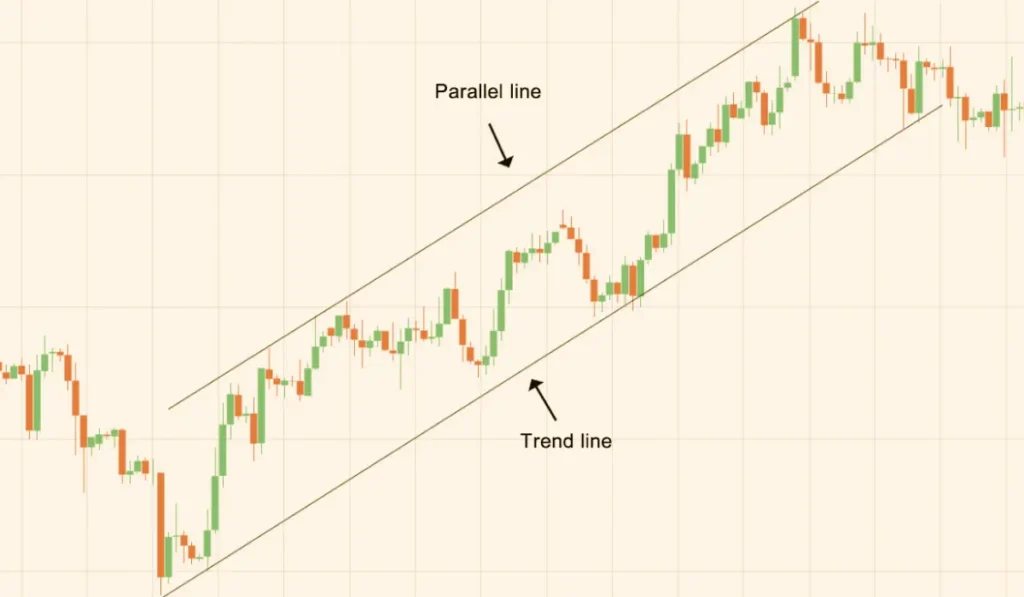
When two parallel trend lines are drawn, it forms a channel. In these two lines, one acts as support and the other acts as resistance. Price moves between these two lines, forming a channel. There are three types of channels:
- An ascending channel where the price moves upward within parallel lines
- A descending channel where the price moves downward within parallel lines
- A horizontal line where the price moves sideways within a range
Channels serve the purpose of highlighting where the price will bounce or reverse.
How to Draw a Price Channel?
Step 1- Draw a Trend Line First
Using swing highs or swing lows, draw a trend line.
Step 2- Copy the Line
Duplicate the trend line and place it on the opposite side of the price fluctuation.
Step 3- Align with Price Highs or Lows
Adjust the second line so it touches multiple price peaks or dips without cutting through candles.
Step 4- Confirm the Channel
A valid channel should have at least two touches on both the upper and lower boundaries.
How Traders Use Trend Lines and Channels?
Traders use trend lines and channels in various ways:
- Entry points
- Breakout trading
- Risk management
- Trend continuation
Mistakes to Avoid
To stop misusing trend lines and channels, remember these don’ts:
- Forcing a trend line where there is no clear line
- Neglecting candlesticks and focusing only on bodies
- Using too few touchpoints
- Not adjusting lines when market structure changes
- Drawing overly steep trend lines that are unrealistic
Note that trend lines are guides, not perfect rules.
Extra Tips for Better Accuracy
- Utilize higher timeframes for stronger trend lines
- Combine trend lines with volume for confirmation
- Check for confluence with support or resistance zones
- Avoid overwriting too many trend lines on one chart
- Practice regularly on demo accounts or historical charts
Final Thoughts
Trend lines and channels are simple but very powerful tools in technical analysis. They provide traders’ insights into market structure, track price movements, and make informed decisions. Though they are not perfect predictors, they offer a clear visual framework for a trading strategy when used correctly. With practice, you will understand how price respects these lines repeatedly across all markets.
If you are just beginning, try drawing trend lines on charts and observing how the price reacts. Over time, this skill will improve and significantly boost your trading confidence.